
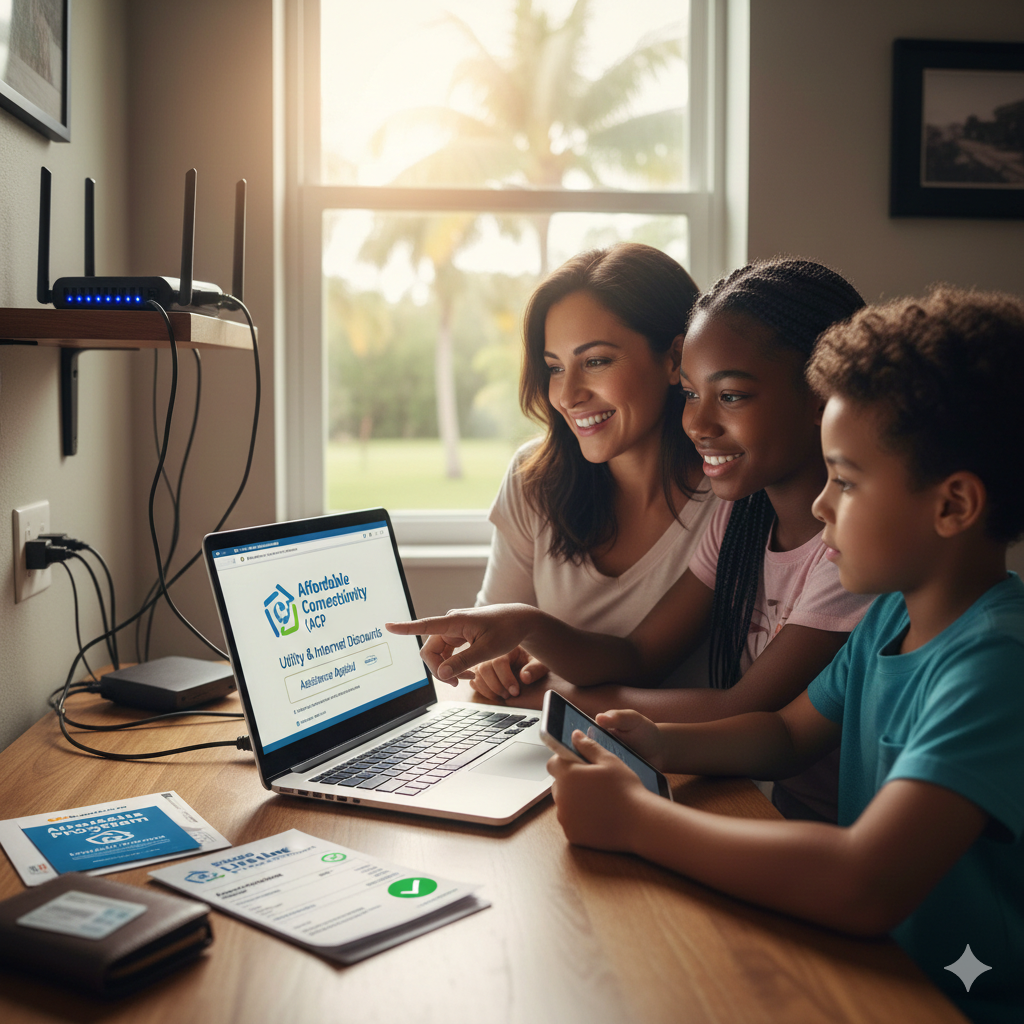
For thousands of Florida households, the monthly EBT deposit for food is just one piece of the survival puzzle. In 2026, with the rising costs of cooling a home in the Florida heat and the absolute necessity of high-speed internet for school and work, “utility poverty” is a growing concern.
While many families are familiar with SNAP, there is a whole ecosystem of broadband and utility assistance programs in Florida that often go unclaimed. From federal grants that pay your electric bill to state programs that discount your internet, this guide explores the essential resources that go beyond food stamps to keep your home connected and powered.
LIHEAP: The Lifeline for Your Electric Bill
The Low-Income Home Energy Assistance Program (LIHEAP) is the primary resource for families struggling with utility costs. In 2026, Florida’s LIHEAP funding has been adjusted to account for the increasing frequency of extreme heat waves.
How it works:
LIHEAP is not a monthly check. Instead, it provides a direct payment to your utility company (like FPL, Duke Energy, or TECO) on your behalf.
-
Home Energy Assistance: A one-time credit to help with regular heating or cooling costs.
-
Crisis Assistance: If you have received a “Shut-off Notice” or your power is already disconnected, you can receive an emergency payment (up to $1,000 in some counties) to restore service.
2026 Eligibility:
To qualify, your household income must generally be at or below 60% of the Florida State Median Income.
-
Example: For a family of four in 2026, the annual income limit is approximately $61,837.
EHEAP: Emergency Help for Seniors (60+)
If there is at least one person aged 60 or older in your home, you may qualify for the Emergency Home Energy Assistance for the Elderly Program (EHEAP).
This program is prioritized during Florida’s peak summer months. It can assist with:
-
Past-due electric, gas, or propane bills.
-
The purchase of portable fans or blankets.
-
Repairs to existing heating/cooling equipment.
Pro Tip: You can often apply for EHEAP even if you have already received LIHEAP, as long as the eligibility periods do not overlap. Contact your local Area Agency on Aging or call 1-800-96-ELDER.
High-Speed Internet: Lifeline and the Post-ACP Landscape
The federal Affordable Connectivity Program (ACP) ended in 2024, leaving a gap for many. However, in 2026, Florida families still have two powerful ways to stay online.
A. The Lifeline Program
Lifeline is the long-standing federal program that provides a monthly discount on communication services.
-
The Benefit: A monthly discount of $9.25 (up to $34.25 on Tribal Lands) that can be applied to either your cell phone plan or your home broadband.
-
Providers in Florida: Major companies like AT&T, Xfinity, and Assurance Wireless participate.
B. Florida’s Office of Broadband Initiatives
In 2026, Florida has expanded its own Broadband Opportunity Program. Many local ISPs (Internet Service Providers) in Florida now offer “Low-Cost Tiers” for families on SNAP or Medicaid. These plans (like Internet Essentials by Comcast or Access by AT&T) typically cost $10 to $20 per month and offer enough speed for a student to attend virtual classes.
Weatherization Assistance Program (WAP)
The best way to lower a utility bill is to stop wasting energy. The Weatherization Assistance Program (WAP) provides free home improvements to make your house more energy-efficient.
What they do for free:
-
Installing attic insulation.
-
Sealing air leaks around windows and doors.
-
Repairing or replacing inefficient water heaters or AC units.
-
Installing LED lighting.
Eligibility: If you receive SSI or TANF, you are often automatically eligible for WAP. Priority is given to families with children, seniors, and people with disabilities.
Utility-Specific “Share the Light” Programs
Most major Florida utility companies have private “charity” funds supported by customer donations and corporate matching. These are often used as a “last resort” when government funds run out.
-
FPL “Care to Share”: Provides up to $750 in emergency assistance once per year.
-
Duke Energy “Share the Light”: Offers flexible payment plans and direct assistance for customers in crisis.
-
TECO “SHARE”: Administered by the Salvation Army, helping families in the Tampa area.
Water Bill Assistance (LIHWAP Updates)
While the federal Low-Income Household Water Assistance Program (LIHWAP) was a temporary pandemic measure, many Florida counties have created local versions for 2026.
-
Volusia and Orange Counties: Often offer local grants up to $600 for past-due water and wastewater bills.
-
Check Your City: Many municipal water departments (like Orlando Utilities Commission – OUC) have their own “Project CARE” to prevent water shut-offs.
How to Apply: The “211” Shortcut
The application process for these programs is decentralized, meaning you don’t apply at the same window as SNAP.
-
Dial 2-1-1: This is the universal number for essential community services in Florida. Operators can tell you exactly which local “Community Action Agency” is currently accepting applications for LIHEAP or EHEAP.
-
Gather Documents: You will need your most recent utility bill, proof of income for all household members, and the Social Security numbers of everyone in the home.
FAQ: Frequently Asked Questions
Can I get LIHEAP if my utilities are included in my rent?
Yes. If you pay an “undesignated” portion of your rent for utilities, or if you have a separate bill, you may still qualify for a modified LIHEAP benefit.
Can I have both Lifeline and a low-cost internet plan?
Yes! You can use your $9.25 Lifeline discount to reduce the cost of a provider’s low-income internet tier, often bringing your total internet bill down to $0 per month.
My power is already off. How fast is “Crisis” assistance?
In Florida, “Crisis” LIHEAP applications are usually processed within 18 to 48 hours. You must provide the “Final Notice” or “Disconnection Notice” to trigger this speed.
Does receiving utility help lower my Food Stamps?
No. In fact, receiving LIHEAP can sometimes increase your SNAP benefits because it allows you to qualify for the Standard Utility Allowance (SUA) deduction without having to prove individual monthly bills.
Conclusion
Staying “Beyond Food Stamps” means looking at your household expenses as a whole. In 2026, Florida families have more options than ever to lower their energy and connectivity costs. Whether it’s a $1,000 LIHEAP grant or a free weatherization upgrade, these programs are designed to keep you in your home and connected to the world.
Pro Tip: Don’t wait for a “Shut-off Notice” to apply. LIHEAP “Regular” assistance is easier to get and requires less paperwork than “Crisis” assistance. Apply during the “Open Enrollment” periods usually found in early Spring and Fall.