
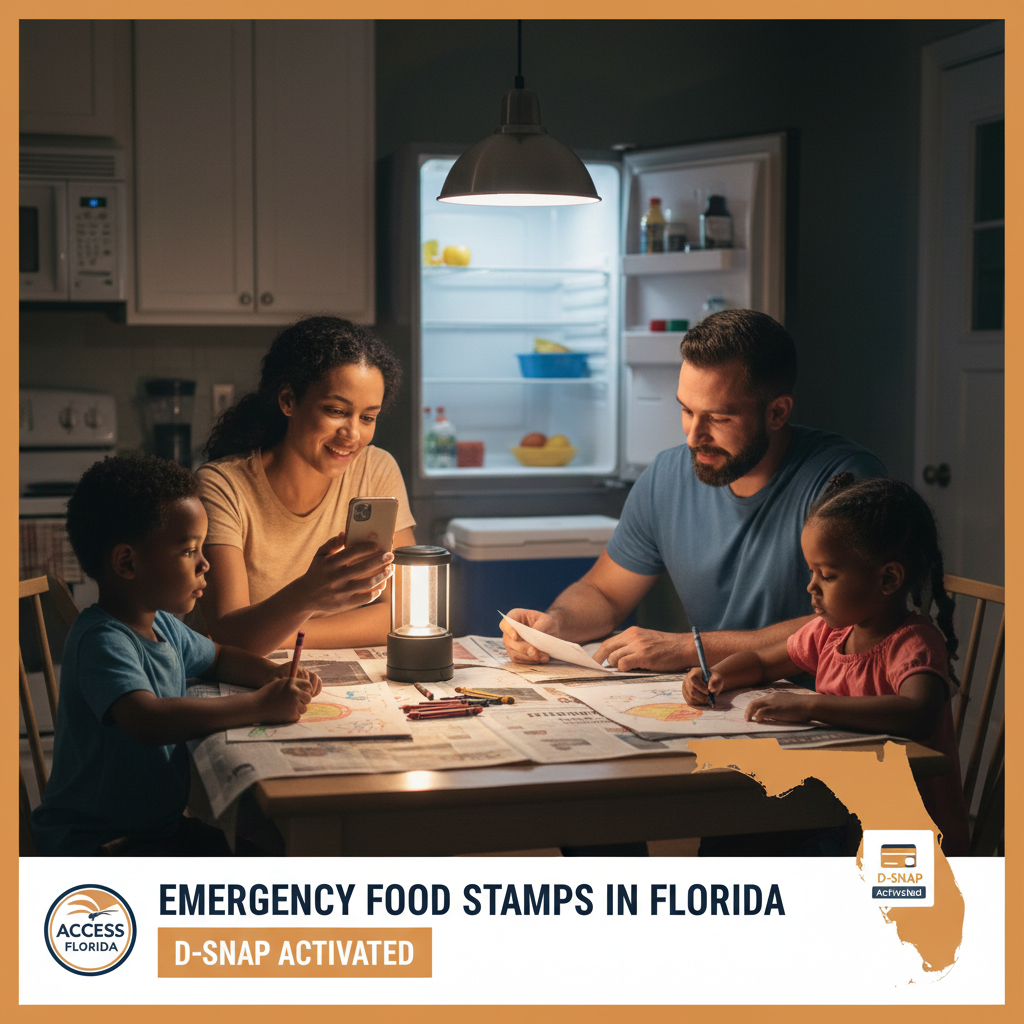
Florida is no stranger to natural disasters. From major hurricanes to flash flooding, an emergency can disrupt your life in seconds, leaving your home without power, your food spoiled, and your income temporarily halted. When this happens, the standard SNAP rules often change to provide immediate relief.
If you are facing a crisis, you need to know about D-SNAP (Disaster SNAP) and Expedited Food Assistance. In this guide, we will cover how to get fast food assistance in Florida during 2026, the eligibility requirements for disaster benefits, and how to replace food lost during a power outage.
D-SNAP vs. Regular SNAP: What’s the Difference?
The Disaster Supplemental Nutrition Assistance Program (D-SNAP) is only activated after a Presidential disaster declaration for “Individual Assistance” in specific Florida counties.
-
Regular SNAP: Based on long-term monthly income and household size.
-
D-SNAP: Designed for people who do not normally qualify for food stamps but have suffered significant financial loss due to a disaster. It typically provides one full month of benefits (the maximum allotment for your household size) in a very short timeframe.
Who Qualifies for D-SNAP in 2026?
To qualify for emergency food stamps after a disaster in Florida, you must meet three main criteria:
A. Residency and Impact
You must have lived or worked in a county that has been officially declared a disaster area. You must also have experienced at least one of the following:
-
Damage to your home or self-employment property.
-
Disaster-related expenses (evacuation costs, home repairs, temporary shelter).
-
Loss of income (your workplace closed, or you couldn’t get to work).
-
Personal injury caused by the disaster.
B. Income and Asset Limits (DGIL)
For 2026, the Disaster Gross Income Limit (DGIL) combines your take-home pay and available cash/savings during the disaster period, minus your disaster-related expenses.
| Household Size | 2026 Disaster Income Limit | Max Benefit Allotment |
| 1 | $2,258 | $298 |
| 2 | $2,716 | $546 |
| 3 | $3,174 | $785 |
| 4 | $3,647 | $994 |
| 5 | $4,143 | $1,183 |
C. Not Currently on SNAP
If you already receive regular monthly food stamps, you cannot apply for D-SNAP. However, you may be eligible for a “supplemental” payment to bring your current benefit up to the maximum allotment for your household size.
How to Apply for D-SNAP in Florida
When a disaster strikes, the Florida Department of Children and Families (DCF) sets up a specific, time-sensitive application window (usually 3 to 7 days).
Step 1: Pre-Registration
The fastest way is to pre-register online through the MyAccessFlorida portal or a dedicated D-SNAP link provided by DCF. This saves hours of waiting in line at a physical site.
Step 2: The Interview
After pre-registering, you must complete an interview. In 2026, Florida often uses a telephonic interview system based on the first letter of your last name.
-
A–F: Day 1
-
G–N: Day 2
-
O–Z: Day 3
-
Everyone: Remaining days
Step 3: Getting Your EBT Card
If approved, your benefits are loaded onto a Florida EBT card. If you already have one from a previous year, it may be reused. If not, DCF will mail one or set up “Direct Pickup” locations in your county.
Food Replacement: What If I Already Have SNAP?
If you are already a SNAP recipient and lose food due to a power outage (lasting 4 hours or more) or flooding, you can request Replacement Benefits.
-
The 10-Day Rule: You must report the loss to DCF within 10 days of the food being destroyed.
-
Proof Required: You may need to show proof of a power outage (like a statement from your utility company or a news report).
-
Benefit Amount: DCF typically replaces the actual value of the lost food, up to your total monthly allotment.
Expedited SNAP: The Faster “Regular” Option
If there is no “Presidential Disaster Declaration” but you are in a personal financial crisis, you should apply for Expedited SNAP.
You qualify for 7-day expedited processing if:
-
Your household has less than $150 in monthly gross income and less than $100 in liquid assets.
-
OR: Your combined monthly income and assets are less than your monthly rent/mortgage and utility costs.
When applying via MyAccessFlorida, the system automatically screens your answers to see if you qualify for this 7-day turnaround.
The “Hot Foods” Waiver
During a declared emergency, Florida often receives a federal waiver allowing SNAP recipients to buy hot, prepared foods. Usually, SNAP only covers “cold” groceries. This waiver is vital if you are living in a hotel or shelter without a kitchen. Look for signs at retailers like Walmart, Publix, and Winn-Dixie that say “Hot Foods Approved.”
Common Mistakes to Avoid
-
Applying Too Early or Too Late: D-SNAP has a very strict window. If you apply before the program is officially open for your county, your application will be denied.
-
Not Documenting Expenses: Keep receipts for ice, chainsaws, hotel stays, and spoiled food. While you may not need them for the initial interview, DCF may audit your case later.
-
Missing the Call: If you choose a phone interview, ensure your “Spam Blocker” is turned off. DCF calls often show up as “Unknown” or “Government.”
FAQ: Emergency Food Assistance
Can I get D-SNAP if I am not a U.S. citizen?
You must meet the same “qualified non-citizen” status required for regular SNAP. However, in extreme disasters, other emergency programs (like those run by the Red Cross) are available regardless of status.
My power was out for 2 days. Can I get D-SNAP?
If D-SNAP is active in your county and you have income/assets below the limit after accounting for your losses, yes. If not, and you are on regular SNAP, you can apply for replacement benefits.
Where are the D-SNAP sites in Florida?
Locations vary by disaster. DCF usually sets up sites in large parking lots, fairgrounds, or community centers (MARCs – Multi-Agency Resource Centers). Check the official MyAccessFlorida homepage for the current list.
Conclusion
Getting Emergency Food Stamps in Florida is about speed and accuracy. In 2026, the digital-first approach through MyAccessFlorida makes it easier than ever to pre-register. Whether you are applying for D-SNAP after a hurricane or requesting a replacement for spoiled food, acting within the 10-day window is the key to ensuring your family stays fed during a crisis.