
The Florida SNAP Schedule determines when recipients will receive their benefits each month. Understanding this schedule is crucial for budgeting and planning. Let’s explore how the schedule works and when you can expect to receive your benefits.
Introduction to Florida SNAP Schedule
What is the SNAP Program?
SNAP, the Supplemental Nutrition Assistance Program, is a federal assistance program designed to help low-income individuals and families in need of food support. In Florida, the program is administered by the Department of Children and Families to ensure that eligible households have access to nutritionally adequate food.
Purpose of the Florida SNAP Schedule
The Florida SNAP Schedule outlines the distribution of benefits to eligible recipients based on their financial situation and household composition. It serves as a guide for both applicants and current participants to understand when and how benefits are provided to help meet their nutritional needs.

Understanding SNAP Benefits in Florida
SNAP Benefits in Florida refer to the Supplemental Nutrition Assistance Program that provides eligible individuals and families with funds to purchase food items. These benefits are intended to help low-income households afford a nutritionally adequate diet. In Florida, the SNAP program is administered by the Department of Children and Families (DCF) to ensure that residents facing financial difficulties have access to essential nutrition.
Types of SNAP Benefits
There are two main types of SNAP benefits in Florida: cash benefits and food benefits. Cash benefits are provided to eligible households to assist with general living expenses, while food benefits are allocated specifically for the purchase of groceries. The amount of benefits received is determined based on factors such as income, household size, and expenses.
Eligibility Criteria for Florida SNAP Program
Income Requirements
Income is one of the main factors determining eligibility for the Florida SNAP program. Eligibility is based on the federal poverty guidelines, and households must have a gross income below a certain threshold. Certain deductions may apply to the calculation of income, such as expenses related to housing, utilities, and dependent care.
Asset Limits
In addition to income requirements, applicants must also meet asset limits to qualify for the Florida SNAP program. Assets such as cash, bank accounts, and investments are taken into consideration. Typically, households must have assets below a certain threshold to be eligible for benefits. However, certain assets, such as a primary residence and personal belongings, may not be counted towards the limit.
Application Process for Florida SNAP Benefits
Overview of the Application Process
Applying for SNAP benefits in Florida is a straightforward process that can be completed online, in person, or by mail. To begin, individuals must gather necessary documents such as identification, proof of income, and expenses. The application form will require personal information, household details, and financial data to determine eligibility for the program.
Submitting the Application
Once the application is completed, it can be submitted through the Florida Department of Children and Families (DCF) website, by visiting a local DCF office, or by mailing the application. It is important to ensure that all required documentation is included to avoid delays in the processing of the application. After submission, applicants may be required to attend an interview to provide further information and clarify any details.

Calculating SNAP Benefits in Florida
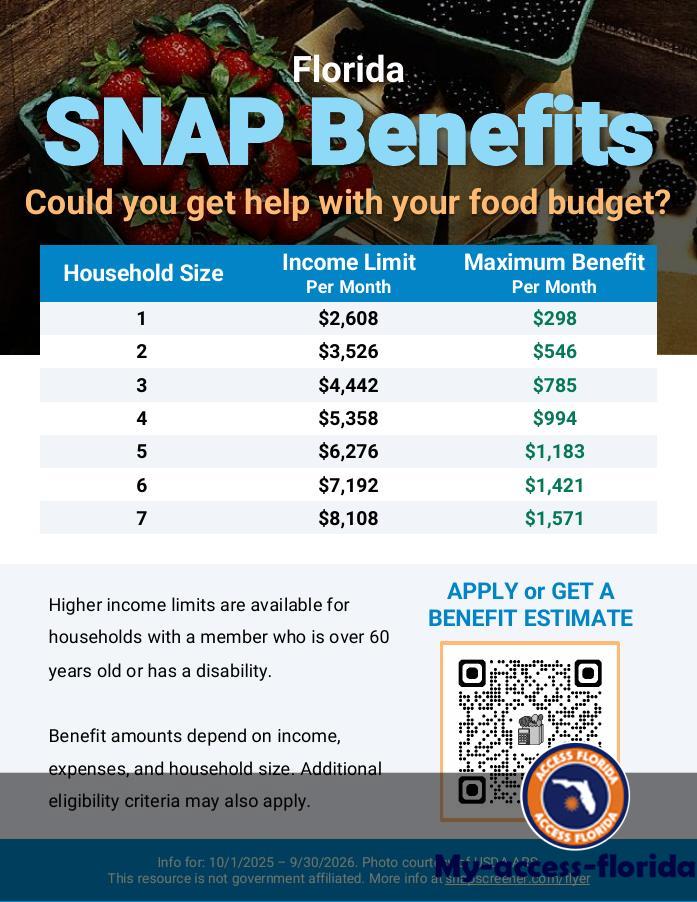
Calculating SNAP benefits in Florida is based on several factors, including household size, income, and expenses. The first step is to determine the maximum benefit amount for the household size. This is done using the Thrifty Food Plan, which sets a standard monthly benefit amount based on the number of people in the household.
Income Calculation
Once the maximum benefit amount is established, the household’s net income is calculated. Net income is determined by subtracting certain deductions, such as a standard deduction and deductions for housing and childcare expenses, from the household’s gross income. The resulting amount is then compared to the maximum benefit amount to determine the household’s SNAP benefit.
Benefit Calculation
The final SNAP benefit amount is calculated by subtracting 30% of the household’s net income from the maximum benefit amount. This ensures that households with lower incomes receive a higher benefit amount. It is important to accurately report all income and expenses to ensure the correct calculation of SNAP benefits in Florida.
Timelines for SNAP Benefit Distribution in Florida
Understanding the **timelines** for **SNAP benefit** distribution in **Florida** is crucial for recipients to effectively plan their **food budget**. In Florida, SNAP benefits are typically distributed on a monthly basis, with the exact date varying depending on the recipient’s case number.
Monthly Distribution Date
The **Florida Department of Children and Families** (DCF) assigns each SNAP recipient a specific date for their benefits to be loaded onto their **EBT card**. This date is determined based on the last digit of the recipient’s case number. It is important for recipients to be aware of this date to ensure they have access to their benefits in a timely manner.
Frequently Asked Questions (FAQs) about Florida SNAP Schedule
What is the Florida SNAP Schedule?
The Florida SNAP Schedule refers to the distribution dates for Supplemental Nutrition Assistance Program (SNAP) benefits in Florida. These benefits are provided to eligible individuals and families to help them purchase nutritious food. The schedule is predetermined by the state and specifies when recipients can expect to receive their benefits each month.
How can I find out my SNAP distribution date?
To find out your SNAP distribution date, you can contact the Florida Department of Children and Families (DCF) or log into your online SNAP account. Alternatively, you can refer to the schedule provided by DCF, which outlines the distribution dates based on the last digit of your case number or other specific criteria.